
Load binders are critical components in cargo securement systems, used together with transport chains to keep heavy loads stable during transit. Although lever-type and ratchet-type load binders serve the same purpose, their structural design, operation method, safety level, and application scenarios differ significantly. Understanding these differences helps ensure safer and more efficient transportation.
1. Working Mechanism and Operation
The most fundamental difference lies in how tension is applied.
A lever-type load binder uses a long handle to create tension through a single, powerful levering motion. Once the chain is connected to both hooks, the operator pulls the lever down to tighten and lock the chain. The tension is applied quickly and directly, relying on mechanical leverage.
In contrast, a ratchet-type load binder uses a threaded screw mechanism combined with a ratcheting gear system. The operator rotates the handle back and forth, gradually shortening the binder and increasing chain tension step by step. This controlled tightening process allows for more gradual force application.
In simple terms, lever binders apply force instantly, while ratchet binders build tension progressively.
2. Safety Performance
Safety is one of the most important considerations when choosing a load binder.
Lever-type binders can store significant tension in the handle during tightening. If the handle slips or is not properly secured, it may snap back suddenly, posing a safety risk to the operator. For this reason, proper training and sometimes additional safety locking devices are recommended.
Ratchet-type binders are generally considered safer because the gear and pawl mechanism prevents sudden release. The tension is distributed through the threaded system, and there is no large stored spring-back force in a single handle movement. This significantly reduces the risk of accidental recoil.
For high-value cargo, heavy loads, or strict safety environments, ratchet binders are often preferred.
3. Physical Effort and Ease of Use
Lever binders require more physical strength because the operator must overcome chain tension in one closing motion. With heavy loads, this can be demanding and may require the use of a cheater bar (which is not always recommended due to safety concerns).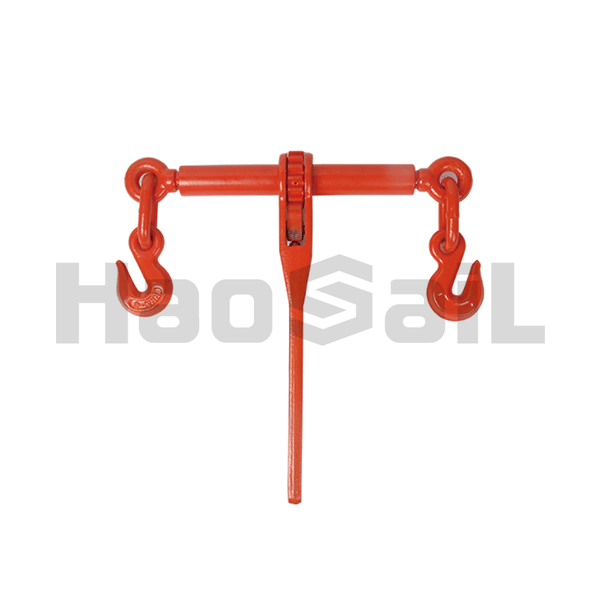
Ratchet binders, on the other hand, require less peak force. The ratcheting action allows the operator to apply force gradually, making the tightening process more manageable and ergonomically friendly, especially for repeated operations.
For operators who frequently secure heavy cargo, ratchet binders reduce fatigue and improve comfort.
4. Tension Control and Precision
Another major difference is tension adjustability.
Lever binders provide limited fine adjustment. Once the chain is hooked and the lever is closed, only small adjustments can be made by repositioning chain links.
Ratchet binders offer much finer tension control because the threaded body allows incremental adjustment. This makes it easier to achieve balanced and precise tension across multiple chains securing the same load.
For applications requiring uniform load distribution, ratchet binders provide better control.
5. Speed and Efficiency
When speed is critical, lever binders have an advantage. They can be tightened very quickly with one strong motion, making them suitable for fast loading and unloading operations.
Ratchet binders take slightly longer because they require multiple handle rotations to reach full tension. However, the trade-off is greater safety and control.
6. Cost and Maintenance
Lever binders typically have a simpler structure and lower manufacturing cost. They are economical and easy to maintain.
Ratchet binders contain more internal components, including gears and threaded systems, which makes them slightly more expensive. However, their enhanced safety and durability often justify the investment for heavy-duty applications.
7. Application Scenarios
Lever-type load binders are commonly used for:
Short-distance transport
Lighter or moderate loads
Situations where quick tightening is required
Cost-sensitive projects
Ratchet-type load binders are ideal for:
Long-distance hauling
Heavy machinery and steel transport
High-safety requirement environments
Frequent, professional cargo securement operations
Conclusion
While both lever-type and ratchet-type load binders are effective cargo securement tools, they differ in force application, safety level, precision, and operational comfort. Lever binders prioritize speed and simplicity, while ratchet binders emphasize safety, control, and ease of use.
About Haosail
we provide both types of load binders to meet diverse transportation and industrial requirements. Built with strict quality standards and engineered for durability, Haosail load binders provide reliable performance in demanding environments worldwide.
Choosing the right binder is not about which is better overall—it is about selecting the one that best fits your load, working conditions, and safety expectations.
7th Floor, Building 93, R&F Headquarters, No. 1 Changcheng South Road, Chengyang District, Qingdao City, Shandong Province, China 266109
Copyright © 2025 Qingdao Haosail Machinery Co., Ltd. All Rights Reserved. Powered by Hicheng


